Four minutes in Luxembourg
Pitching Quantanomous at Luxembourg Venture Days: one idea, one deadline, a decision that did not go our way, and the conversations that came after.
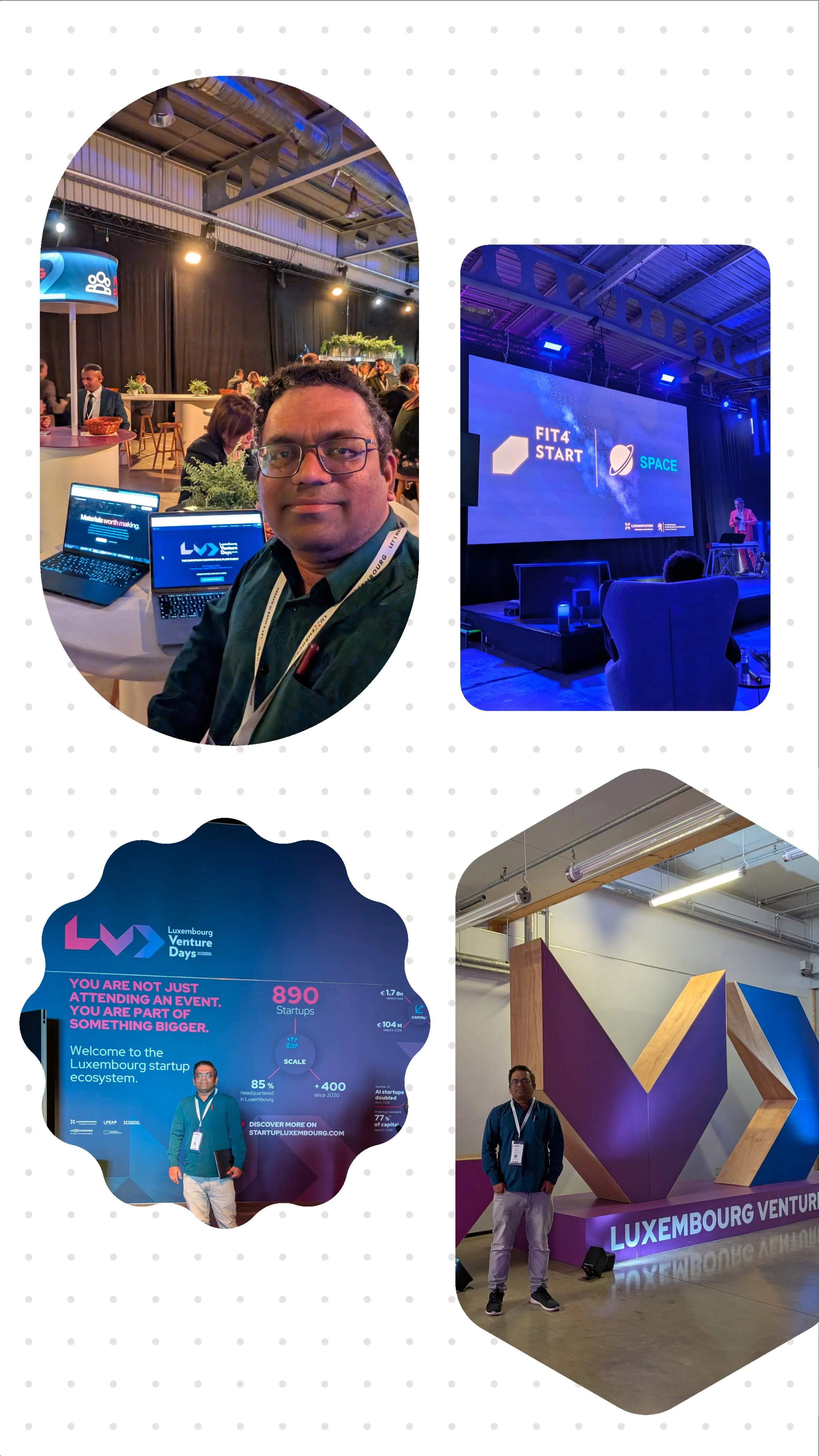
On 14 and 15 October, my co-founder Suhas Yadav and I pitched Quantanomous at Luxembourg Venture Days, at Luxexpo The Box. We were one of the startups pre-selected from a record 556 applications to pitch for Fit 4 Start, the acceleration programme that Luxinnovation runs with Luxembourg’s Ministry of the Economy.
The format is unforgiving: four minutes to present, then four minutes of questions from the jury.
Cutting a decade of physics down to one idea
For a scientist, the hardest part of a pitch is not what to say. It is what to leave out. I have spent about ten years computing the properties of molecules and materials with high-accuracy methods on Europe’s supercomputers, and the honest first draft of our pitch tried to explain all of it.
We kept cutting until one idea was left. Computers can already suggest thousands of promising new materials; that part is no longer hard. But making and testing even one candidate in a lab costs months and real money, so engineers act on a prediction only when they know how far to trust it. Most predictions do not come with that answer.
That is what Quantanomous is built for. Our app turns the properties a product needs into ranked candidate materials. It learns from high-accuracy quantum mechanics, rules out toxic, costly or scarce elements before the search begins, and puts a calibrated uncertainty on every prediction, so lab time goes only where it is likely to pay off.
A deadline everyone in the room has met
Every juror has relied on a piezoelectric ceramic, whether they know it or not. These ceramics turn pressure into an electrical signal and back again. They sit inside medical ultrasound probes, sonar, parking sensors and haptic screens, and behind the mirrors of the lithography machines that make chips. Most of them are made of lead zirconate titanate.
In Europe that now has an end date: the exemption that allows lead in these ceramics expires on 31 December 2027. Taking the lead out is only half the problem, because the best-known substitutes depend on bismuth or niobium, raw materials the European Union already ranks as strategic or critical. Swapping a toxic element for a scarce one does not solve much. Finding compositions that avoid both is our first market.
The decision
On 15 October, Luxinnovation announced the 24 startups of the 17th Fit 4 Start cohort. Quantanomous was not among them.
I would rather write that plainly than leave it out. With 24 places across four tracks and a record number of applicants, many strong teams did not make the final list, and we were one of them. The preparation was not wasted: the pitch, the deck and the answers we sharpened for the jury are now the core of every investor conversation we have.
The conversations that came after
The pitches are only one part of Luxembourg Venture Days. The rest is two days of meetings between founders and investors, and that is where the event paid off for us.
Before the event, we wrote to investors and asked for ten minutes at the venue. On site, we had longer conversations with several venture investors, some of whom asked for our deck. Since then we have sent it and are setting up follow-up calls as we prepare our seed round.
What I would tell a scientist about to pitch
- Start with something the listener already knows. An ultrasound scan or a parking sensor does more work in ten seconds than any explanation of the method.
- Describe what the method buys, not what it is. “A calibrated uncertainty” means little to a jury. “Knowing which candidates are worth the cost of a lab test” means a lot.
- Use plain words, then test them. Read your opening to a friend who is not a scientist, and fix every word they ask about.
What comes next
Our seed round continues, and so does the search for partners. If you make or use piezoelectric ceramics, in medical ultrasound, sonar, automotive sensing, haptics, precision motion or semiconductor equipment, and the 2027 deadline is on your desk, I would be glad to talk.
Next week I also start Google for Startups Immersion, powered by Antler, which I write about in selected for Google for Startups Immersion.
Thank you to Luxinnovation and the Fit 4 Start team for the pre-selection, to the jury for their questions, to everyone who stopped to talk with us at Luxexpo, and to my co-founders Suhas Yadav, Hemanadhan Myneni and Arunkumar Rajan.
Learn more about Quantanomous at quantanomous.com.
About the Author

I'm Dr. Ravindra Shinde, a computational physicist and quantum chemist. My work spans quantum chemistry, condensed matter physics, AI for materials, and scientific computing: I use and develop electronic-structure methods to understand how electrons shape the properties of molecules and materials, and I build the software that makes those calculations possible.
Continue reading
Selected for Google for Startups Immersion
I have been selected for Google for Startups Immersion, powered by Antler: years of high-accuracy materials modelling, now inside a product, and a programme built to take it further.

A day at Amazon Amsterdam
A visit to the Amazon office in Amsterdam, and knowledge to carry into upcoming ventures.
75 million CPU hours on LUMI for quantum Monte Carlo forces
Our EuroHPC project, Learning from Quantum Monte Carlo Forces, has been awarded 75 million CPU hours on the LUMI supercomputer.